29 Dec 2025
Now and then I come across creations that I so wish were my own: by some magic the artist captures the world in a way I simply know is true—deep, fresh, sturdy, whimsical, wise. How do they do that? How do they use the artifice of their medium to show the truth of our existence? Well they may not be my own creations, and yet, in that link of humanity between us, they are mine, and I am theirs, and that’s what keeps this whole thing afloat.
Here are some of the things I found and loved this year:
Fiction
How I loved Marc Behm’s The Eye of the Beholder! A private detective obsessively stalks and protects a serial killer over the years; he imagines her as his long-lost daughter. A dream-logic sad-cop noir, I guess; fans of Disco Elysium will feel right at home here.
I also had a blast with Solvej Balle’s On the Calculation of Volume (I’ve read volumes I and II). It’s a time loop story, like Groundhog Day or Edge of Tomorrow, and yet not at all like them; there is no mission, no life lesson, just the absurd notion of this impossibility actually happening and its effects on the protagonist’s family and love life, and on her outlook on consciousness and existence. I was amazed at how fresh it stayed after two full volumes, and I’m looking forward to the rest.
Carissa Orlando’s The September House was a very fun read: the titular house is haunted, and its owner (our narrator) oddly doesn’t mind, except in September when the walls bleed and the spirits get so dangerous no amount of exorcism seems to help. Or is the owner going mad?
Also huge fun: Tony Tulathimutte’s Rejection, a book of short stories on the topic of rejection. But reader beware: I hesitate as this is the cringiest, raunchiest, most misanthropic recommendation I’ve made in this blog, and it may well not be for you.
In an entirely different note, the atypically slim Something to Do with Paying Attention, from David Foster Wallace (an excerpt from The Pale King), has one of the best descriptions of a phenomenon of deep attunement with the moment that I’ve felt now and then, never enough, an experience full of attention and serenity though not necessarily joy, and that I find so difficult to replicate at will, or even to describe. Wallace calls it doubling, others of course call it mindfulness or aliveness, and this novella is worth reading for this description alone.
One unexpected perk of having kids is the discovery that Children’s Literature is often better than grown-up literature at expressing deep insights in raw form. With our kids getting older I risk drifting away from these gems, but a late find this year was Blake Nuto’s A Day That’s Ours (lovingly illustrated by Vyara Boyadjieva). The book is precious, and describes precious time.
Non-Fiction
My last read of the year was also one of the best: Eliot Weinberger’s An Elemental Thing. It is a collection of collage essays spanning millenia and the whole world, with an emphasis on pre-Columbian and Ancient Chinese cultures, mysticism, and the elemental. It feels incredibly eclectic, and I do mean “incredibly” literally: at several points I balked, thinking “there’s no way that’s true”, only to confirm Weinberger’s facts by myself. I don’t know how he finds these things; I don’t know how he puts them together. It’s a marvel.
It seems I have yet to mention the philosopher Byung-Chul Han in this blog. I’m not sure why, as I love his works; the latest of his I’ve read is Vita Contemplativa. It is a book written “in praise of inactivity” and contemplation, not as a means to recharge and become more productive, but as an end in itself, one we as a culture are losing the ability to even recognize.
A single memoir on this list: Sarah Wynn-Williams’s Careless People, a chronicle of her time as a Facebook executive; the “careless people” were her peers from Zuckerberg and Sandberg down, and the target of their carelessness is our own social fabric. A constant stream of jaw-dropping, appalling behaviour from these clowns. I don’t usually read this kind of book, but Meta barred Wynn-Williams from promoting it so, action-reaction, I felt I had to. It’s good.
This year I went from deep, curmodgeonly scepticism about anything AI coding-agents related, to some degree of surprise, to vertigo, to the realization that my craft has changed irrevocably in the deepest ways. I learned how (and how not) to use Anthropic’s Claude Code and… it has been a deeply liberating feeling. For instance, there is a category of personal computing problems that I could solve given enough time—say half a day. But I never solve them because I never give myself the half-day to do so. When a good prompt gets the tool to do it in ten minutes, well. I blaze through them. Essential for me in navigating this space is the prolific blog of Simon Willison, who steers clear of the hype and shows by example what can be done, and how.
I have a soft spot for earnest self-improvement texts. I particularly enjoyed three this year. Oliver Burkeman’s Meditations for Mortals is a set of insightful essays that go against the grain of the typical productivity literature, best read daily over four weeks as he suggests (I also recommend his blog, The Imperfectionist, with similar topics). Through Burkeman I learned of Paul Looman’s I’ve Got Time, a rare advice book that I still find helpful months after reading. And Brendan Barca and Pema Sherpa’s The Daily Buddhist is a devotional book that has accompanied me for the better part of the year, and has been a source of inspiration throughout.
I started this year chronically injured and believing I wouldn’t be able to run again, and I’m closing it with a habit of 5-6 runs per week. I’ll have more to say about my recovery in a future blog post, but a key piece was learning about the neuroplastic component of chronic pain, as described very accessibly by Alan Gordon and Alon Ziv’s The Way Out. If you struggle with chronic pain, this is a good entrypoint to figure out what to do about it.
TV and Movies
So many good movies this year! Ryan Coogler’s Sinners may have been my favourite: vampires in the 1930s Mississipi Delta are drawn to the transcendental power of Blues music. Sui-generis, raw and pulsating.
Ari Aster’s Eddington is a neo-Western about an explosive confrontation between a small town Sheriff and Mayor at the start of COVID, featuring those mask debates and conspiracy theories I’d rather not think about again except in a format as good and unpredictable as this.
Paul Thomas Anderson’s One Battle After Another features pathetic far-right wingnuts, somehow (as so often) in power, hapless left extremists (very much like those in Are You Willing to Die for the Cause?), and the regular people caught up in this mess. This makes it sound like a downer, but the movie is preposterous fun.
Kathryn Bigelow’s nightmarish A House of Dynamite loops through the same nuclear threat sequence three times, each time from a perspective at a power rung above the previous (and more bafflingly incompetent the higher we go). I found strong echoes of Allison and Zelikow’s excellent Essence of Decision in the treatment.
And finally, just out on theatres, Josh Safdie’s frenetic Marty Supreme is true to the theme: like a table tennis point, the plot swings from major threat to major save (to double-major threat…) at exhilarating top speed.
Four good TV shows: Severance’s second season was as much a knockout as the first; a delight. The Beast in Me is a thriller with Claire Danes as an author writing a book about her potentially murderous next-door neighbour, played by Matthew Rhys—slight connections with Hitchcock’s “Rear Window.” Following Rhys led me to the fantastic The Americans, about deep undercover Soviet spies in 1980s Washington posing as a regular couple, kids included—we’re halfway through the second season and enjoying it all. And Pluribus just finished its first season. The premise (an alien virus transforms nearly all of humanity into a placid, content hive; we follow an uninfected woman making sense of it) is great, and while it’s still to be determined whether it will end a great show, it’s worthwhile so far.
Games
Cooperative games continue to evolve and rack up awards, and I’m happy to see that. The one I enjoyed the most this year is the Slay the Spire boardgame. It is a pretty perfect adaptation of the excellent videogame, and the cooperative aspect meant I was able to have long hours of fun playing it with my son and friends. In Bomb Busters (which won the Spiel des Jahres award) the players are bomb defusers working collaboratively to defuse ever harder challenges; in Earthborne Rangers they are rangers in a post-apocalyptic wilderness, much of the fun is discovering the world around them; and in Fate of the Fellowship they are characters in the Lord of the Rings trying to destroy the One Ring and stop the onslaught of the Dark Forces—the game adapts the Pandemic system quite effectively.
Turing Tumble is a wonderfully inventive toy: a mechanism to build marble-powered computers, Plinko board-style. Supposedly for kids.
Perhaps the game I enjoyed playing the most is Blue Prince, a puzzle adventure videogame filled to the brim with mysteries, a slightly eerie atmosphere, and enough randomness to avoid things getting stale. We’ve solved the “main” puzzle (“find the 46th room of this ever-changing 45 room mansion”), but there are still so many loose ends that we’re coming back for more.
Miscellaneous
My musical discovery of the year was Frank Dupree—wonderful talent, brilliant choices, so much energy. Check him out with a Big Band Kapustin concerto here.
We visited Toronto in June. It’s still a lovely city, and within its St Lawrence Market you can still, after all these years, find the generous man from Honey World providing sample after sample of delicious honey. And we found he sells it online! Never have I had as much honey as I’ve had since June.
Meanwhile, back in Victoria, Ay Mi Mexico is our new favourite Mexican food restaurant (their consomé de birria and tacos de pastor are great). And after Charelli’s closed at the start of the year, the next best place to find great cheeses became The Farmer’s Daughter, in Sidney.
We had guest birders this year, and ambling around town with them made me appreciate the drama and beauty of the world of birds hidden in plain sight. Along with their guidance, the Merlin app (“Shazam for birds”) and a good pair of binoculars (I got the Celestron 8x42 Trailseeker ED) were crucial. Speaking of birds, our visit to The Raptors, in Duncan, was a blast.
Finally, I learned about the Clark Geomatics maps recently—specifically the Salish Sea and the Vancouver Island ones. They are astoundingly beautiful. An excellent level of detail and cartographic decisions. I don’t have the wall space for them all; I wish I did!
As ever, I enjoy hearing from you if you liked (or didn’t!) any of these recommendations, or if you have something I might like. Have a fantastic 2026!
(Previously:
2024,
2023,
2022,
2021,
2020,
2019,
2018,
2017,
2016,
2015,
…)
31 Dec 2024
I’m a truffle hog, sniffing for those tasty treasures hiding under the expanse of bland mediocrity that is our culture. This year I have a bumper crop for you to enjoy!
Fiction
Let’s start with Jacqueline Harpman’s astounding “I Who Have Never Known Men”—though it is a difficult start, since I don’t know what to say that won’t spoil your discovery. A girl is captive in a strange prison among women, all the jailers men; nobody remembers why they’re there nor even where they are. A slim but powerful book, written with wisdom and generosity, about our quest to understand the world. Nominally science fiction, but don’t let that stop you.
Then we have Olga Tokarczuk’s “Drive Your Plow Over the Bones of the Dead”, in which an eccentric, aging, Blake-loving woman attempts to convince her neighbours that vengeful animals are causing the gruesome deaths in their village. Charming, funny, and wily.
Samantha Harvey’s “Orbital”, in contrast, is meditative and passive—observing the world from a clarifying distance. The premise is simple: the thoughts of six astronauts in the International Space Station as they orbit Earth during 24 hours. The plot does not go much further beyond that, but that does not matter: the insights that come from coursing above everything we know, above friends and strangers, routine and hope and tragedy, sixteen times per day, are enthralling.
Two from the genius of Helen deWitt this year. “The English Understand Wool” is very short, perfectly crafted, delicious. I would have enjoyed its exacting voice regardless of plot, but the acerbic jabs at the publishing industry were sugar on top. If you, like me, devour it in one sitting and need more, then go on to her “Lightning Rods” to be—well—struck by a bolt of wickedness. A LinkedIn/TED tryhard figures out how to deal with sexual harassment complaints: by giving top performers anonymous “lightning rods” to channel their urges; he goes on to build a business empire and reshape America. The corporate and political satire is brutal and revolting, and made even better by the cringeworthy, positive thinking language of the characters.
A fascination with revulsion is also the engine of A. K. Blakemore’s macabre “The Glutton”, the (real!) story of a boy with an insatiable and abominable appetite in revolutionary France. Blakemore approaches the thesaurus ravenously, like Tarare approaches the world, and the result is the best kind of disgusting: a bizarre feast.
Far more digestible is Christopher Buehlman’s “The Blacktongue Thief”. It may be the most tight and fun fantasy I’ve ever read? In any case, it’s what, to my mind, fantasy often promises and fails to deliver. It’s smart, fast, fresh, just surreal and scary enough.
Dashiell Hammett’s “The Maltese Falcon” is of course a classic, as you surely already know. What you may not know (I didn’t) is how fun it is to read it, how lean its prose is, and how cool its setting. Half of the secret, I think, is that Hammett never tells you what anyone thinks or feels, merely what they do, and so the narrative is propulsive and cinematic.
Two subtle gems: first, Giuseppe Tomasi di Lampedusa’s “The Leopard”, a historical novel on the social changes and the loss of nobility of the Sicilian aristocracy during the Risorgimento, and Claire Keegan’s “Foster”, a perfect novella of a girl attempting to find familial affection.
In Spanish, the best book I read was Alvaro Enrigue’s “Tu sueño imperios han sido”, a Borgesian, sometimes psychedelic, reimagining of the baffling history of the conquest of Mexico. I understand that the English translation (“You Dreamed of Empires”) is very good too.
Antonio Barba’s “El último día de la vida anterior” was another highlight: a surreal, fantastical ghost story. If you can read Spanish be sure to check it out—I don’t think it has been translated yet.
Poetry
Fiona Benson’s “Ephemeron” has a delightful range, from the careful look at insect love in its first section, through the retelling of the myth of the Minotaur, to the pain and hope of parenting.
There are roughly two stories in Shane McCrae’s sharp “Sometimes I Never Suffered”: that of the “hastily assembled angel” plummeting to Earth, and that of a mixed race American reaching Heaven after a life of sorrow: If I’ve earned my reward where is the life where I can spend it?
Non-fiction
The most eye-opening book I read this year was Stefanie Green’s “This Is Assisted Dying”. It’s also the only one that made me cry; I would be surprised if it didn’t have that power on you too. Green (a Victoria resident) is a pioneer of medically assisted dying in Canada, and this book narrates the journey to establish her practice, the experiences of her patients, and a de-mystification of the process. I am grateful for Green’s expertise, warmth, and persistence: not only because she has stopped so much suffering in the world first-hand already, but also because, through her advocacy, she has made it viable for you and me to stop ours, should the need arise.
Also enlightening: Hannah Ritchie’s “Not the End of the World”, on the climate crisis. Ritchie’s data-driven argument is that climate doomerism is both counterproductive and unwarranted. Counterproductive because it prevents action (if we are hosed anyway, what’s the point?); unwarranted because there are indeed things we can do to prevent and mitigate the worst of the crisis.
TV and Movies
“Anatomy of a Fall” is such an intelligent film. A man falls to his death from a window in his wintry chalet; did his wife kill him? Should their son lie on the stand? Fantastic writing and performances.
If you want more falls and deaths in the snow, there are dozens of them in the zany “Hundreds of Beavers”, a bizarro slapstick comedy done with skill and originality. Bugs Bunny for grownups.
Three excellent horror-inspired films that are nevertheless not horror: the naughty “Saltburn”, a kind of vampire story without actual vampires; the visually stunning “Poor Things”, a feminist Frankenstein story; and the mad-and-getting-madder body horror of “The Substance”, with a brilliant return from Demi Moore.
Also, a local theatre (the Vic) re-screened “Run Lola Run” on occasion of its 25th release anniversary. What a fun movie that was! The frantic story, the free willed editing, the music… if you can catch it again, it truly rewards a second viewing. If you’re new to it, I am jealous. The same theatre re-screened “Whiplash” (ten years out), a nerve-racking, jaw-dropping jolt to the senses. Both of these really reward viewing them loud, by the way.
Four tentative TV recommendations: “Silo”, with a theme quite similar to my first recommendation up top, had a great first season (the second, ongoing, is so far darker and flabbier); “Kaos”, a modern-day retelling of Greek myth with Jeff Goldblum as a neurotic Zeus, showed so much promise only to get cancelled; “3 Body Problem” would have been fantastic were it to provide any sense of closure at the end of the season; “Wolf Hall” is smart and delicate, and enjoyable if you don’t mind long scenes of courtiers taking off their hats over and over.
Miscellaneous
The Belfry Theatre brought in “The Lehman Trilogy”, on the rise and fall of Lehman Brothers. It was a masterful production with a great cast. If it ever comes again (or goes wherever you are), I’m confident you’ll love it. And if you can’t find it, the book itself, by Massini and Power, is great reading.
I’ve been enjoying Sam Kriss’s Substack, “Numb at the Lodge”, and admiring it for often going where my mind has been too lazy or cowardly to go on its own.
Two game recommendations: “Ready Set Bet” is a really fun horse-betting boardgame—you can try and figure out the odds, but the payouts will change as other players figure the odds themselves, and as the facts on the racetrack evolve. And the “Minute Cryptic” daily online puzzle is delightful, as it has been scratching the itch that early Wordle gave me (yes I still do the Wordle). If you’re stumped, make sure you watch the explanatory videos for each day; after a week or two you’ll be solving the cryptics far more expertly.
The Beryl AX Router was a nice discovery: a travel-friendly, easy-to-use router that I’ve used to boost the signal in hotel rooms, to simplify the connectivity from several devices, and even at home when we’ve had router trouble.
In Victoria
We’re so lucky in this town! Four Victoria pleasures to wrap up: in the morning, expertly baked croissants from Goodside Pastry House; for lunch, cute and delicious boxes from Yua Bistro; for dinner, pizza, arcades, and 80s nerdy vibes at Pinhalla, and to close, two scoops from Parachute Ice Cream—my favourite is the Oatmeal Chocolate Chip Cookie, but I’ve enjoyed them all.
I’ve just realized I’ve been doing these recommendations series for fifteen years now! People sometimes tell me they enjoy them, and that they discovered something great through them. If that’s you, thank you for reaching out! It means a lot, and keeps me wanting to come back a year later. While I always have hopes of resurrecting this blog for other purposes (there’s always next year), this has been the one constant all this time.
Do reach out if you have recommendations for me as well. Happy New Year!
(Previously:
2023,
2022,
2021,
2020,
2019,
2018,
2017,
2016,
2015,
2014,
…)
31 Dec 2023
Another year panning for gold, another year finding wondrous nuggets in our cultural stream. Here are some of my favourites:
Non-fiction
This year, my surroundings opened up to interpretation like never before, and I have Tristan Gooley’s books to thank for it. I read “How to Read Nature” and “The Natural Navigator” in puzzlement by the mystery of why would extremely practical and life-enriching pointers such as these not be better known. The shape of the trees around you indicates the path of the sun! A glance at the crescent moon, or at a flag flapping in the wind, is often enough to get your bearings! It’s astounding, the stuff we are oblivious to, and that Gooley points out effectively and lovingly.
In the late nineties, I would listen to Pulp nonstop. I imagined the band leader, Jarvis Cocker to be a kindred spirit, going by lyrics and sensitivities alone, in the naive way a fan does with their stars. Then for a long time I stopped listening to them. When I revisited them, I was apprehensive: I’ve found other early musical loves cringeworthy in hindsight. But Pulp still holds up pretty well, and Cocker may be a kindred spirit after all, judging by the excellent “Good Pop Bad Pop”: a sort of memoir of his and the band’s early days that is funny, endearing, and seductive.
Wally Koval’s “Accidentally Wes Anderson” is a coffee table book with a compilation of places and things that match the director’s aesthetic. They are a joy to browse—and note that you can do that on the website rather than on the page. Not every photo lands—these shots sometimes aim at a parody rather than the original, the way ChatGPT can parrot the caricature of a poem with none of its soul—but when they do they’re exquisite.
I wrote recently of my love for Chris Oliveros’ “Are you willing to die for the cause?”, and I must include it in my year-end list as well. An oral history in comic-book form about the Québec revolutionaries of the 1960s with implications for activism today.
Finally, Steve Easterbrook’s “Computing the Climate” is a great overview of the early and current work to model our climate. I’m biased, of course—Steve was my doctoral advisor—, but I can proudly and safely recommend it to everyone looking to understand how climate science is done, regardless of their previous knowledge on the matter. There are fascinating bits here everywhere, from the earliest models, calculated by hand a century ago, to the bleeding edge work at the top climate centres in the world, and they are explained with care and with respect for your intelligence.
Fiction
Speaking of climate change: I wonder if Paul Murray’s “The Bee Sting” might not be the best novel published on the topic. Or rather, and perhaps because, it’s not about climate change, but about our attitude when the writing is on the wall, when something bad is about to happen and everyone can see it, but they still can’t help play their part in the unfolding tragedy. The sense of impending doom is personal and familial rather than societal, and that makes it more real. The novel doesn’t beat any drums, and it is about many, many other things as well: secrets, isolation, status, money, love, sexuality, the mystical in the modern, the tides that carry us, and the hurt we are responsible for; patterns that reverberate and harmonize through 600+ gripping pages. Wonderful, darkly comic, but also painful.
For something lighter, how about a murder mystery? Last year I pointed to a book by Stuart Turton (“The Seven Deaths…”), this year, I’m happy to recommend another one, “The Devil and the Dark Water”. A sort of Holmes and Watson pair work to tackle an impossible puzzle of a murder at sea. Impossible unless they accept the supernatural as an explanation—should they? A very fun read.
I loved Clare Pollard’s translation of Ovid’s “Heroides”. It’s an ancient text, but it feels fresh even now! The poem is structured in the form of letters from women in myth—letters in which the writers (Phaedra, Medea, Penelope, and others) describe their plights and their dilemmas. Pollard says it is “a daring act of literary transvestism” for Ovid to have taken this on, and I agree. She also points out it is the first book of dramatic monologues, and the first example we have of epistolary fiction. And it is so good, so raw, so human!
There is a podcast, Backlisted, which I discovered this year but can only take in very small doses, as it’s full of great book recommendations that would take me forever to chase. For instance, these three are books they mentioned, that I adored, and that I’d like to pass on to you: first, Raymond Briggs’ “Fungus the Bogeyman”, a delightfully dour children’s picture book depicting the life of a working class monster. Second, Jessica Au’s “Cold Enough for Snow”, a slim, calm, meditative novel about a mother-daughter holiday in Japan, and third, Pete Dexter’s “Deadwood”, a fantastically good western—no connection to the also great HBO show, or at least no connection that HBO would want to acknowledge.
TV and Movies
This was the year that “Succession” wrapped up, and what an absolute knockout of a last season that was. If you haven’t seen it, I’m afraid my superlatives might turn you off—and yet I can’t remember being stunned like this by a TV show before. Deliciously clever writing, wonderful acting, just perfect in every way.
But if a dark tragicomedy of greed and power is not your thing, how about “The Leftovers”? A seemingly random 2% of the population vanishes in an instant; the series picks up in the aftermath as those left over struggle to maintain their social order and their mental health in the face of the absurd and unexplainable. At times nightmarishly Lynchean—the first season has echoes of “Twin Peaks”—, the series succeeds thanks to its heart and unpredictability.
Two simpler but very enjoyable shows: “Extraordinary” is set in a world like ours, but where everyone gets superhero powers when they reach adulthood, except for our protagonist, a plainly ordinary woman. It’s very silly fun. And the case-of-the-week show “Poker Face” features a drifter with one key asset: the uncanny ability to tell when someone is lying. As in Columbo, you know who did it from the start, but you still want to see how the case gets solved.
Were you as nonplussed as I was by the adaptation of The Sandman to the screen? If so, then let me suggest Jim Jarmusch’s “Only Lovers Left Alive” as the fix to your ailments—such a good movie! A despondent vampire wonders why he should keep waking up every night among the “zombie” mortals; his wife comes over to lift his spirits. It’s everything there is to love from the classic issue “The sound of her wings”, set to gorgeous photography, music, and performances, and none of that dumb CGI.
Finally, what a ride “Triangle of Sadness” was! The smartest movie I’ve seen in a while—it’s also fiercely anti-ideological, original, surprising, and funny. I shouldn’t try and summarize it for you; it’s one of those films that benefits from going in not knowing what to expect. I can’t wait to see what Östlund does next.
Games
It was also a good year for games for me. The very best find, I think, was Cole Wehrle’s Pax Pamir, a board game in which players take the role of local Afghan leaders trying to navigate the “Great Game” of geopolitics played by the empires above them. It is technically innovative and tight—I heard it described as a knife fight in a phone booth—, extremely tactical, with multiple plausible strategies, and crafted so that all players have a reasonable shot at victory until the end. At the same time, it is illustrative on the role of local powers in empire-building, and on an aspect of world history I was not familiar with. The components are beautiful, but you can also play the game online at Rally the Troops.
Years ago, I recommended Flamme Rouge as a game that I felt got bicycle races intuitively right. I feel the same now about Granerud and Pedersen’s Heat: Pedal to the Metal, for car racing: the rules are simple and elegant, and they push you to get to the finish line with all you’ve got, your machine about to blow up—unless maybe you pushed it a bit too much. Lighter fare than Pax Pamir, and far easier to teach too I believe.
A late, wonderful discovery, was the most recent Spiel des Jahres winner, Dorfromantik, designed by Michael Palm and Lukas Zach. I became so fond of this game, perhaps because it reminds me so much of Carcassonne, the game that got me into modern Euro designs. Dorfromantik, in fact, looks like an evolved, mature, corrected Carcassonne—similar to the evolution from The Legend of Zelda: Breath of the Wild to Tears of the Kingdom. It is a cooperative “campaign” game (early successes unlock more tiles and complexity), and it works perfectly fine as a solo game. Challenging at higher levels, and addictive.
On the Switch, I also enjoyed playing Chants of Sennaar with my son. A unique game of linguistic puzzles—the task is to piece together utterly foreign languages—, with an inspired aesthetic and a fine story.
Others
I had no idea that Nick Cave, the musician, had such an expansive, loving soul. In his website, The Red Hand Files, he takes on questions from random strangers, and gives back compassionate, wise, heartfelt answers. I read them carefully whenever a new one pops up.
One podcast recommendation (other than the aforementioned Backlisted): the epic takedowns of airport bestsellers that is If Books Could Kill, with Michael Hobbes and Peter Shamshiri. Smart, funny, and good at pointing out just what is off about the usual suspects hogging the mike all the time.
I have been trying to wean myself off of Google this year. I feel like I’ve had enough of it, and the less I give them the better we’ll be. I’m still checking alternatives to their mail and calendar applications, but I found it easy to get off their maps and browsers. Search is crucial, and for that the key for me was learning about Kagi. I switched to it and I haven’t looked back. The search results are great, and there are no ads. The price seems fair for not being the product myself.
To cure your clogged-mailbox-and-dozens-of-browser-tabs syndrome, I’m happy to suggest Omnivore, the best Read Later service I’ve found. Free, open source, cross-platform, beautifully designed. Send your newsletters there, send your open tabs there as well, then take them on when you have the dedicated time to clear them.
Finally, if you are in Victoria, drop by the Dumpling Drop downtown for some fantastic food. Vegan options available; top it up with a Kid Sister popsicle from their freezer, then coffee from the reliably good Hey Happy or the just as good but far less well known Saint Cecilia nearby. And if you do go, let me know and I’ll join you! It will give me a brilliant excuse to have some more myself.
I believe that’s it. I hope you found something above that tickled your curiosity. If you did, I’d love to learn about it, as well as about any of your own finds. Happy New Year!
(Previously:
2022,
2021,
2020,
2019,
2018,
2017,
2016,
2015,
2014,
2013,
…)
11 Nov 2023
I approached Andreas Malm‘s “How to Blow Up a Pipeline” with some trepidation, after reading positive coverage, either of the book or of the movie based upon it, from people I respect.
Trepidation because I knew the gist of its argument (for attacks on property to fight climate change), yet I am both temperamentally and pragmatically nonviolent.
Would the enormity of the climate crisis and the arguments in this pamphlet change my outlook?
Turn me into an advocate for, and a perpetrator of, property destruction to help stop the rise in carbon emissions?
Would it lead me to sabotage?
That would have been a very tall order, for me.
I admire Gene Sharp and his writings.
I’ve read and been convinced by Erica Chenoweth‘s and Maria Stephan‘s studies about the statistical analysis on the superiority of nonviolent tactics.
I watched with despair first-hand as the peaceful messages from G20 protesters in Toronto were hijacked by black bloc doofuses, burnt in a dynamic of pointless vandalism and indiscriminate repression.
I admire the practical emphasis on nonviolent civil disobedience by Extinction Rebellion and Just Stop Oil
(setting soup-throwing-into-artworks incidents and their ilk aside, of course—these hurt nothing except our collective intelligence).
Still—global warming is an enormous problem, and I have turned my life around on a good argument several times.
What if Malm is right?
Well, I shouldn’t have bothered.
“How to Blow Up a Pipeline” turned out to be one of the sloppiest and most irresponsible arguments I’ve read in print in a long time.
It is sloppy in its analysis of nonviolent protest, and irresponsible in its careless endorsement of sabotage.
On his analysis against nonviolent protest, Malm makes three main points:
(1) sometimes violence is necessary, as when faced against a mass shooter, so anyone who thinks they are nonviolent are fooling themselves,
(2) pragmatic nonviolent icons are not the doves they’re cracked up to be, and
(3) what if nonviolence doesn’t work and our commitment to it is a waste of time?
Each of these has glaringly obvious replies —
(1) a systemic, slowly unfolding problem is not a mass shooter,
(2) so what?, and
(3) any approach could indeed fail, but some may go beyond failure and poison the cause; why wouldn’t “try a couple of bombs” fail even worse?
But Malm doesn’t see these replies.
I have the sense that he’s too drunk with retributive power to see them.
Early in his book, he narrates how he and his friends would go out at night and puncture the tires of SUVs, calling themselves, with baffling tone-deafness, the “Indians of the Concrete Jungle” (no, I’m not making it up, I wish).
The idea was to instill fear in the hearts of wasteful motorists.
He claims, with zero evidence, that drops in SUV sales are a result of his fine slasher work.
Malm thinks that that’s the path to follow, just amped up by a kiloton or two.
He disses the climate movement as too doughy, too mild-mannered—he repeats a criticism of Extinction Rebellion kids looking like they just stepped out of a community theatre
(rather than the proper anarchist uniform he sports, I guess).
Not edgy enough!
He feels that someone should, you know, really do something.
If someone just had blown up some infrastructure, some light sabotage here and there, a decade or two ago, that would’ve taught them a lesson, and maybe we’d already be on our way out of this crisis.
He’s not saying that everyone should be violent, but hey.
A bit of diversity of tactics! Normie protesters with their cute signs and community organizers and children over there, bomb throwers over here, all working in harmony for a common but not quite articulated goal.
It really is a good thing for him that the supposedly common goal is left as an exercise for the reader, because I doubt that spelling it out would gain him much traction in the mainstream.
Reading between the lines, the ambition goes, predictably, way beyond stopping carbon emissions—indeed it doesn’t even seem to be primarily about that.
Because Malm takes as a premise that you simply cannot fix the problem under our economic systems.
So it follows that you must overthrow the government, and not just yours, as this is a global problem, but nearly every government in the world, and institute in its place, I suppose, a worldwide Leninist regime?
Something that will ban property everywhere, in any case, as he warns us that “property will cost us the earth”.
This is how we get to the trope that plagues so much left commentary of late:
if you want to avert the collapse of our civilization, you must bring about the collapse of our civilization.
Best to leave all of this unsaid in your sales pitch!
Let’s say, instead, that of course, we will take the utmost care in not hurting anybody.
Of course, our acts of sabotage won’t ever be thought of as terrorism by the public:
we’ll define terrorism in a way that doesn’t cover us and everyone will adopt our definition!
Of course, the targets will be selected surgically and with a galaxy-brain analysis of the impact of our actions.
And ah of course, of course, uhm someone else should actually do the deed?
Maybe some kid somewhere?
Malm himself would in principle get his hands dirty, he just uh, hasn’t gotten around to it yet. He’s the brains of this outfit!
Well what does he think would happen if we listened to him?
When the opponent has the most sophisticated surveillance technology and the most devastating weapons in existence?
A couple of well-placed bombs, the oil companies fold, the system is brought to its knees, the spell is broken, blood is left unspilled, the blinkers come off of everybody’s eyes, then a radical transformation of every aspect of life and a magical eco-utopia?
Are we on a matinée action movie?
That really is the level of strategic thinking here.
Even Jacobin is telling Malm to come off it, and these are the guys who sell DIY guillotine posters!
Reading Malm I was doubting myself: how is this taken seriously by anyone?
What am I missing?
Which is why it was so refreshing, coming out of “How to Blow Up a Pipeline?” to read Chris Oliveros’ new and excellent “Are You Willing to Die for the Cause?”, a graphic novel about the Québec revolutionaries of the 1960s.
Different situation, but so many similarities!
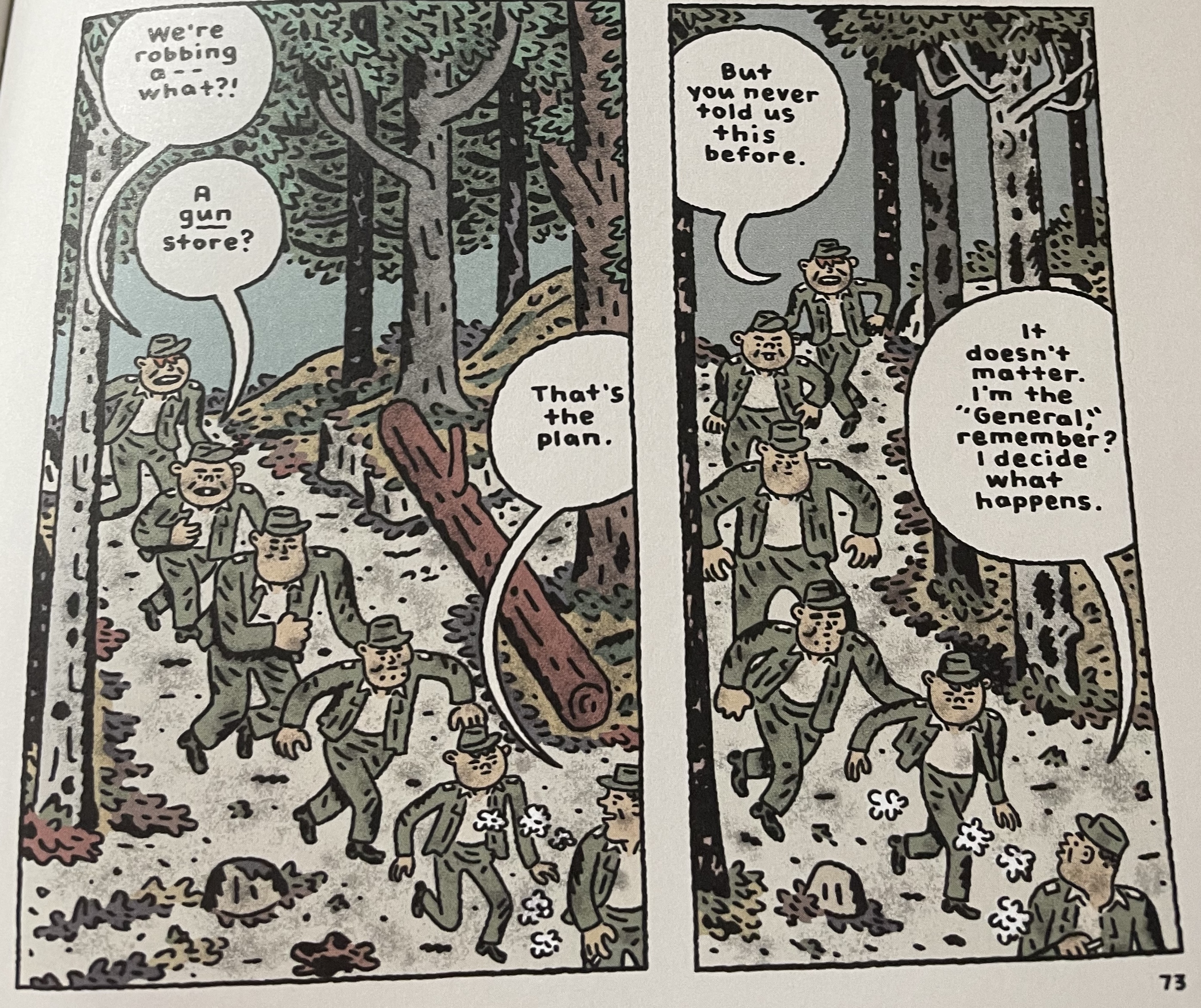
It’s all there: pseudo-intellectual windbags egging each other…
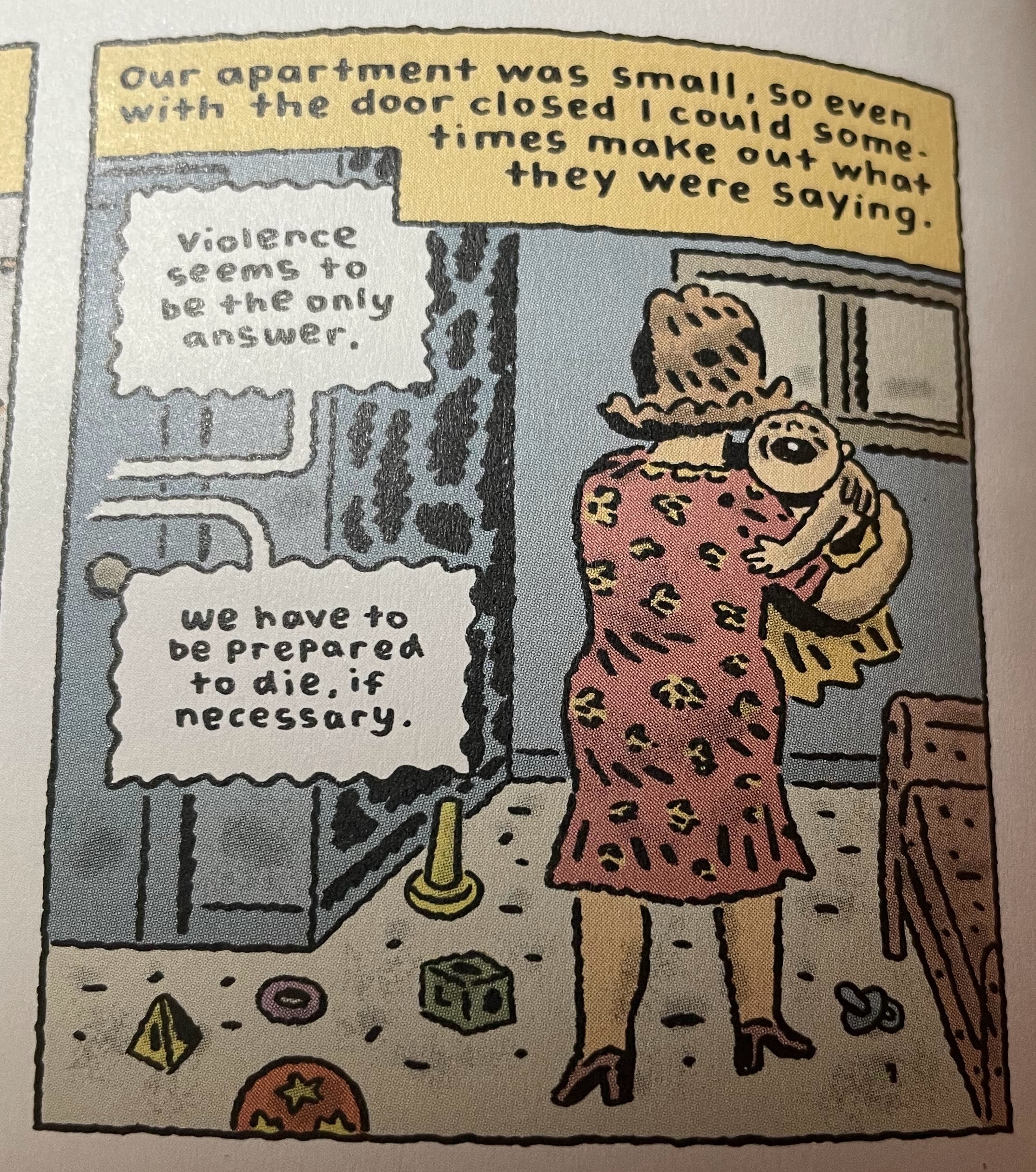
…the Che cosplay…
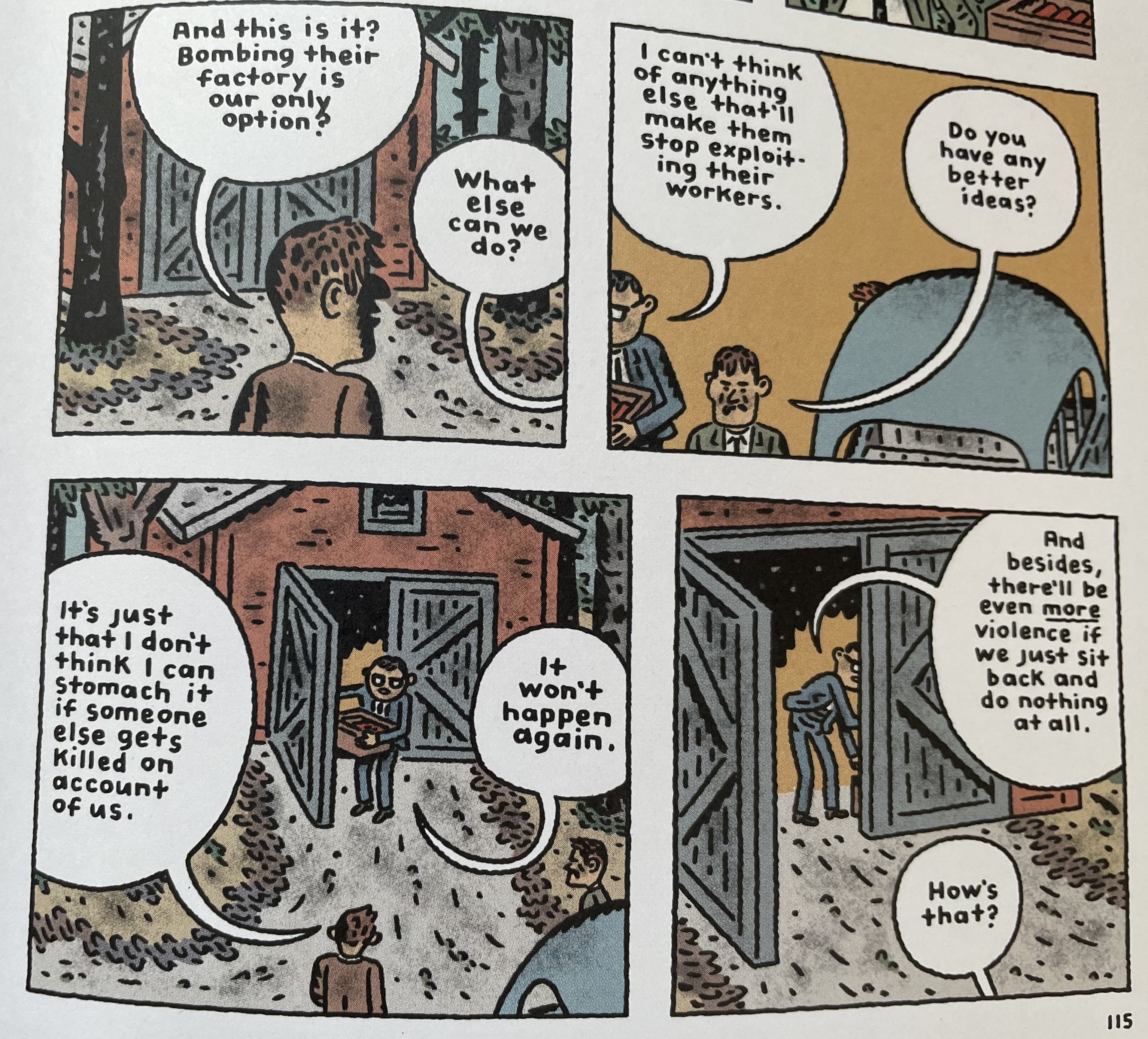
…the lazy “there would be even more damage if we don’t do this” rationalizing…
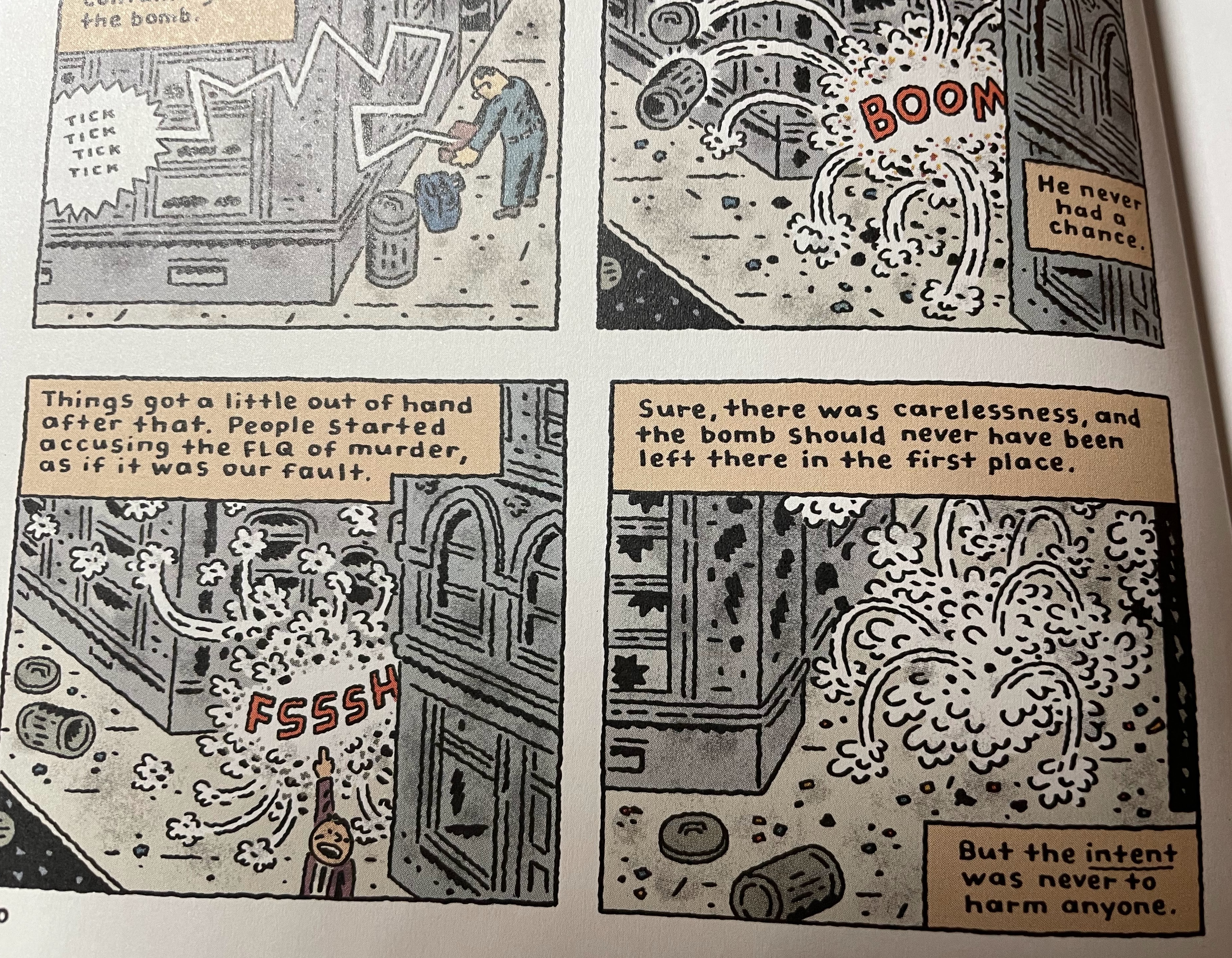
…the “it will be just property damage” good intentions…
…the poor kids not knowing what they’re getting into…
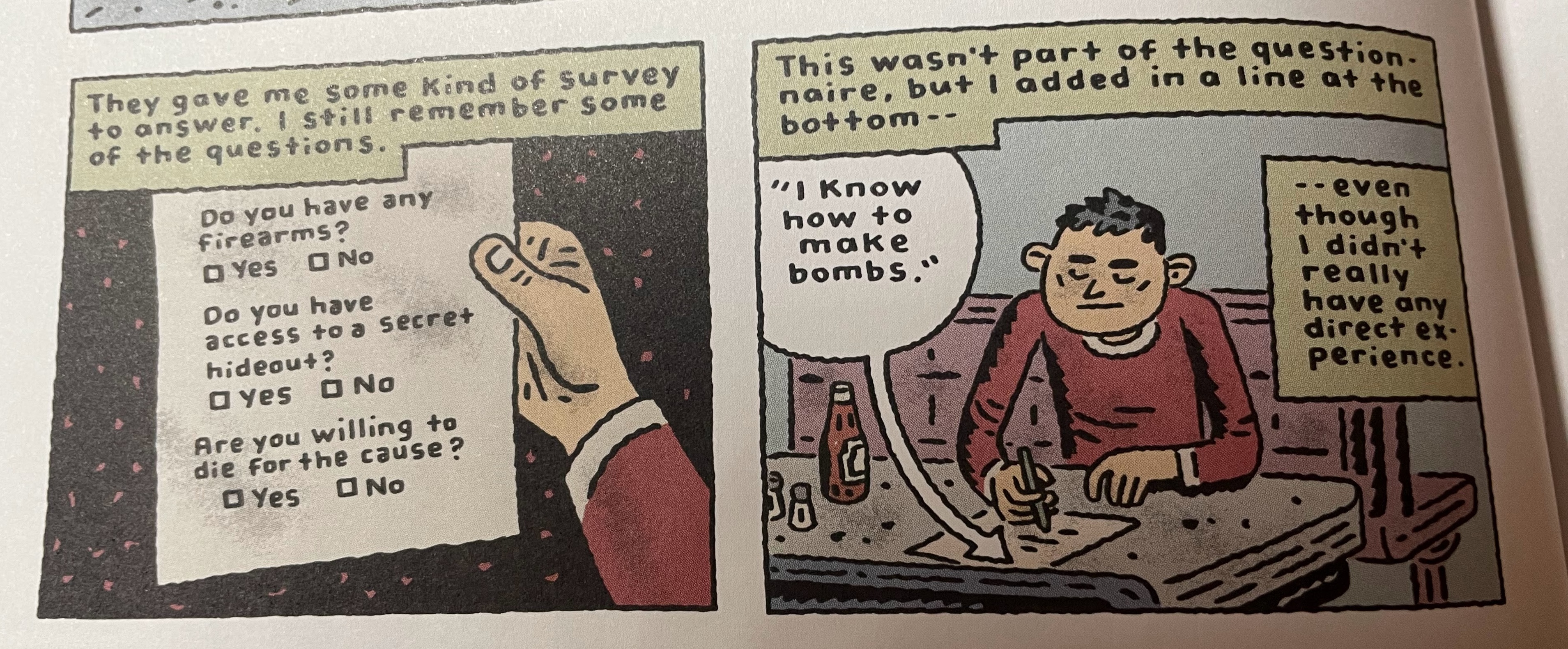
…the stupidly unnecessary deaths…
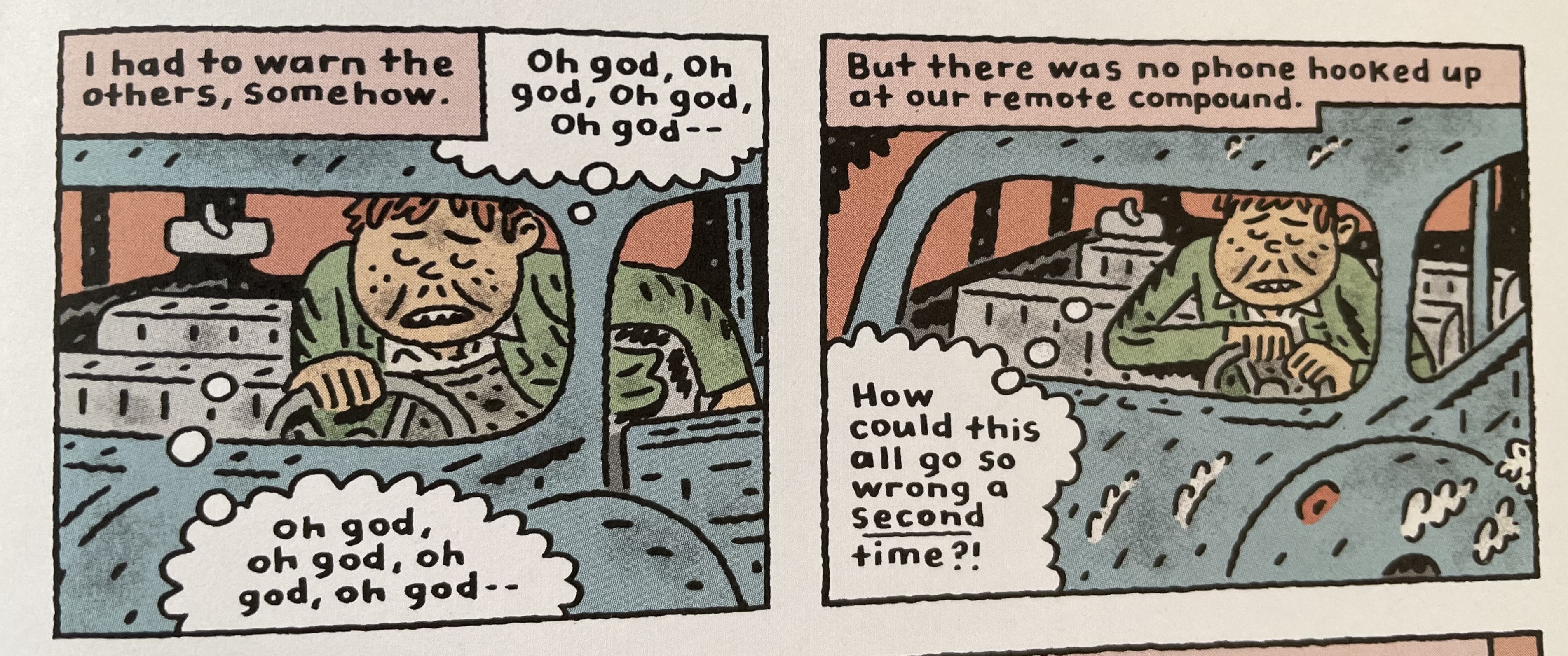
…the predictable reaction of the state…
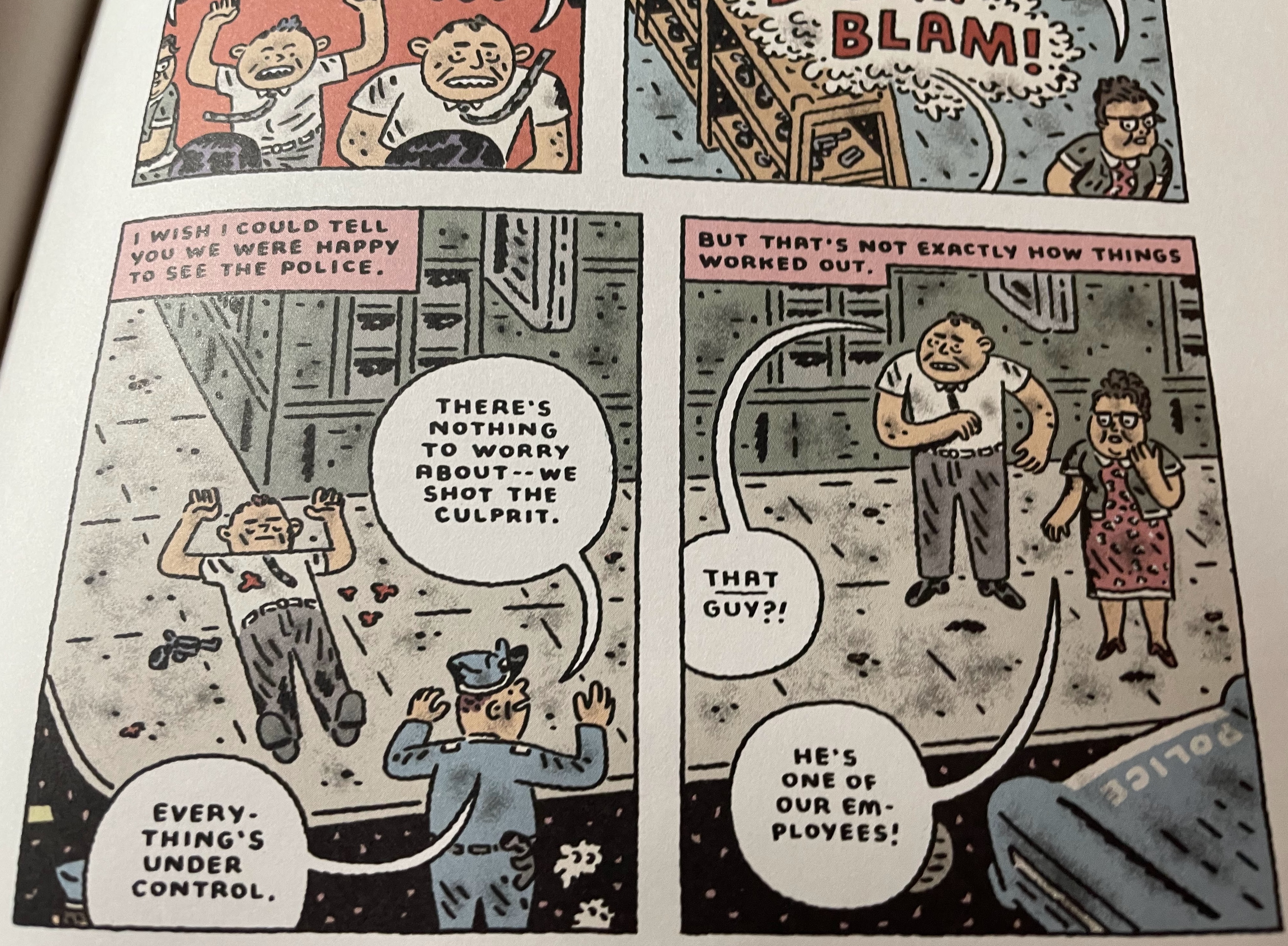
The same course of action staring back at us, from sixty years ago!
The same tragedies to avoid, for those who want to listen—and we’re lucky that most in the climate movement have, so far.
I don’t know what it is about Oliveros’ writing, or about his graphic style, that works so well at conveying the deadly, assured cluelessness of these fellows; their futility.
I just hope that, sixty years from now, people will have managed to navigate out of this crisis without falling into the same traps, without the same kinds of self-inflicted wounds.
And it’s possible.
We are seeing progress on multiple fronts (too, too slow, yes), we have the high ground, and public opinion is vastly on our side.
Let’s not blow it.
31 Dec 2022
When you look for a recipe online, do you quickly scroll past the long reminiscences about growing up on a farm and Nonna’s secret spices? Me too. So let’s just skip the preamble here and get to the good stuff:
Fiction
I had a blast with Turton’s “The Seven Deaths of Evelyn Hardcastle”. I really couldn’t put it down… in fact I had so much fun that I read it all again a second time the moment I finished it! Without spoiling much, I would describe it as a combination of Groundhog Day, Agatha Christie mysteries, and Quantum Leap, and if any of those appeal to you, I think you’re going to love it.
DeWitt’s “The Last Samurai” was also fun, although a fun of a different kind. Denser, concerned with learning, exploring, non-conforming—concerned with genius, I suppose, but a genius that here feels within reach. It is also about parental and filial love, and it is surprisingly touching.
I’ve recommended many of Ursula LeGuin’s books before. This year I read “The Word for World is Forest”, and I think it is another gem. She explores colonialism, exploitation, violence, and cultural infection. Needless to say, it is a sad book. Also a very Taoist one.
Two more old books, but new to me. First, “The Great Gatsby”. How is it so good? I was dreading either a stiff solemn tragedy on ambition and hubris, or glitzy Leonardo DiCaprio, bootleg whiskey, and flappers. But Fitzgerald’s short book about class is neither. Instead it is fun, clever, nimble, quirky, beautifully written, and still relevant.
The other old book I only recently read is John Williams’ “Stoner”. I knew nothing about it—nor about Williams—when I picked it up at the bookstore, except that it was in the Staff Picks section. The cover was boring and one of the blurbs referred to the novel as “quiet.” It’s a campus book, and campus books tend to be rather meh. You are told what will happen to Stoner within the first paragraph, and it isn’t much of consequence. And yet, I think this is my favourite book of the year. It is wise, kind, observant, and it praises the persistent, dedicated, imperfect, and loving work that so many do every day to keep what is good alive.
Non-fiction
If you approach self-help books with the same kind of subtle shame I do (it’s hard to admit you may need help, and that you are naive enough to think you might find it in a place as full of quacks and hucksters and fakers as the self-improvement genre), you’ll find much to like in Schaffner’s “The Art of Self-Improvement”. Schaffner studies the self-help literature academically, distilling what the best of these books are trying to say, what do they value, how has their advice changed over time, and how our stance about improving ourselves bleeds into the political domain. The result is enlightening.
“How to Invent Everything”, by Ryan North, is a book that I’ve always wanted, but I had never known how to ask for it. Want to know how to make fertilizer, soap, or baking soda from scratch? Glass or steel? Simple machines, musical scales, paper? How to find salt or domesticate animals? It’s all here, under the premise that you are stuck back in time and need to get civilization going by yourself. More instructive by far than any classroom lectures I’ve attended—this is what popular science books should be. Very funny, very cool.
Davies’ “Extreme Economies” attempts to understand economics by looking at what happens when certain conditions of social life are at the edge: refugee camps, prisons, failed states, reconstruction after a disaster, extreme old age, and so forth. I appreciated the novelty of the idea more than its execution, but I still found it quite valuable.
Kate Beaton’s “Ducks”, a graphic memoir of Beaton’s two years working in the Alberta oil sands, is both deeply personal and broadly useful to understand what it’s like out there. I don’t know why the graphic medium is so good at conveying everyday life in the far north, but it works.—and Beaton is so talented at conveying emotion and thought visually, in a seemingly effortless manner, that the book is a joy to read. (Don’t take my word for it either! This book is my one point of overlap with Obama’s own book recommendations for the year.)
Finally, in Reilly’s “The Staff Engineer’s Path” I found a fantastic description of what it is I should be doing and thinking about at this stage of my career. It is thorough, kind, supportive, and full of practical advice. Highly recommended.
Poetry
“The Carrying”, by Ada Limón, spoke to me particularly well. Limón’s poems deal with both the mundane and the transcendental—and with the fact that you get to the latter via the former. They are like gardens: productive, weedy, a miniature universal struggle. They are full of life and death. Not every poem hits, of course, and Limón is very immersed in the United States. This is an American book, often a very NPR book. But when these elements are quieter, it’s also a humane, joyful, empathetic, sorrowful experience.
Film and TV
So much to share! But I have to start with the wonderful “Everything Everywhere All at Once”. What an exhilarating experience! Goofy and profound and fresh and thrilling.
Some fun movies: “Glass Onion”, while not as mind-blowingly good as “Knives Out”, is still excellent. Rian Johnson and Daniel Craig seem to be having a lot of fun, and we are all the better for it. “Confess, Fletch” is a light dry noir comedy, and shows that Jon Hamm can be quite funny. And after watching Val Kilmer’s appearance in the new Top Gun, I remembered an early movie of his that I thought was a classic, only to discover it is half-forgotten: “Top Secret!” Old comedy often grows stale but this is still so good—cheesy, zany, dumb fun.
On TV, I thought “Severance” was nearly perfect. Stylistically precise and gorgeous in its surreal and sterile corporate propaganda aesthetic; narratively tight and complex. The one small knock against it is that the finale leaves more out than in, and the second season won’t come out for a while, so it feels incomplete. “Slow Horses” is astute and twisty, and Gary Oldman is a delight in his role. “Only Murders in the Building” has a cheeky look at the true crime podcasting genre and great character interactions; both seasons so far have been quite enjoyable.
I’m surprising myself a bit by recommending something from the Star Wars franchise, but “Andor” was excellent as well. I read somewhere that it’s like The Wire on space, and while I certainly would not go that far, the comparison aims in the right direction: Andor is a sociological story of resistance and insurgence, with full-fledged characters with complex motivations. No lightsabers in sight.
Sports stuff
I started running more seriously again this year, and to a lesser extent, swimming. A few things have helped me a lot: for my running, the approach in Fitzgerald’s “80/20 Running” has been exceptionally good—it helped me realize I had been going too hard in previous years (leading to injury and an overall decreased mileage), and how to craft better running plans for myself. I’ve also made heavy use of my Garmin Forerunner 255, of some rolls of KT Tape, and of a Roll Recovery R8 Plus self-massager.
In the water, my big obstacle for the longest time was the lack of goggles that wouldn’t leak. No goggles I tried would help, and I tried a lot of them—I suppose they don’t make them with my head shape in mind—, which meant stopping frequently to drain them and putting up with the red itchy eyes afterward. However, this year I found the goggles from THEMAGIC5, which are custom-made to your face: you submit a face scan and get a 3D-printed fit for you. The effect is miraculous, with absolutely zero leaks. They are a bit pricey, but they essentially unlocked swimming for me. I love them.
Miscellaneous
The best source to navigate the war in Ukraine has been the series of columns from Lawrence Freedman in Comment is Freed. Such a bright strategic mind, with so much clarity of thought. Whether it is the possibility of nuclear war, the potential angles of a peace negotiation, or the tactical positions of each army, I learned a lot about how to think of these issues from Freedman’s approach. Similarly, Hannah Ritchie, in her Substack and Twitter feed (oh, Twitter…) cuts through the misinformation and doomscrolling of our climate crisis to present an evidence-based, highly numerate, and useful climate commentary.
One boardgame I enjoyed this year was Cascadia. Winner of the Spiel des Jahres, and based in the fauna of the Pacific Northwest, it’s a deep game with a moderately simple ruleset. Another one was also nominated to the same award: SCOUT, a trick-taking card game with even simpler rules but an amazing execution. And finally, the WASGIJ? puzzle series gives a good spin to the classic jigsaw puzzle model by asking you to assemble not what you see in the box, but what a character within sees, or what will happen later.
Yet again this was a difficult year for the world. I do think though that art, books, stories, and beauty provide not just—or not necessarily—escapism to cope, but a deep value worth fighting for; a window into what we actually are, what we want, and how we can reach contentment. I hope you find a nugget or two for yourself in the list above. Until next time!
(Previously:
2021,
2020,
2019,
2018,
2017,
2016,
2015,
2014,
2013,
2012,
…)